


TPC Sawgrass - Dye's Valley Course

Rating Snapshot


About
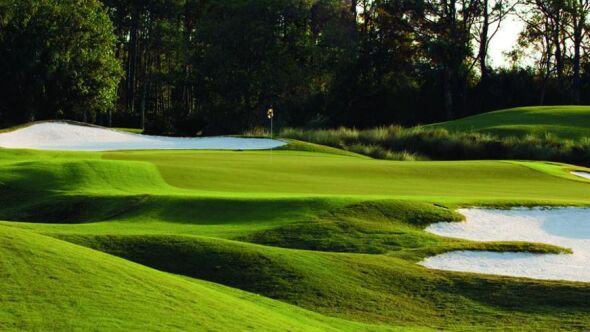
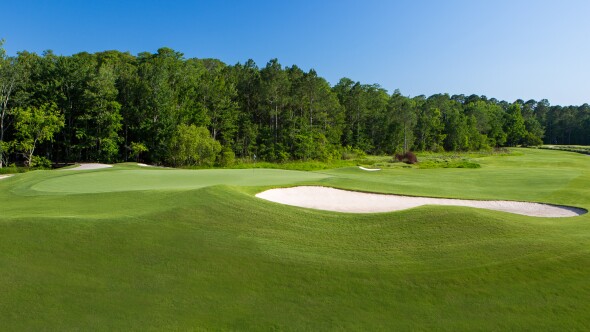
Sharing a home with the renowned Stadium Course can be intimidating, but Pete Dye's Valley Course at TPC Sawgrass is definitely able to hold its own. The golf course features large greens and an abundance of water that sprawl across rolling hills and valleys. During a renovation in 2006, more than 300 trees were added to the golf course and several bunkers were reconstructed to make them more challenging. One of the most notable holes is the 350-yard third. What this par-4 lacks in length, it makes up for in difficulty with a fairway that slopes sharply to the left and a tightly manicured collection area that is twelve feet below the level of the green.
| Tee | Par | Length | Rating | Slope |
|---|---|---|---|---|
| TPC | 72 | 6847 yards | 73.8 | 138 |
| Blue | 72 | 6502 yards | 71.9 | 135 |
| Blended Blue/White | 72 | 6272 yards | 70.8 | 133 |
| White | 72 | 6079 yards | 69.9 | 132 |
| White (W) | 72 | 6079 yards | 75.7 | 139 |
| Blended White/Green (W) | 72 | 5526 yards | 72.0 | 131 |
| Blended White/Green | 72 | 5526 yards | 67.4 | 127 |
| Green | 72 | 5126 yards | 65.8 | 123 |
| Green (W) | 72 | 5126 yards | 70.0 | 127 |
| Hole | 1 | 2 | 3 | 4 | 5 | 6 | 7 | 8 | 9 | Out | 10 | 11 | 12 | 13 | 14 | 15 | 16 | 17 | 18 | In | Total |
|---|---|---|---|---|---|---|---|---|---|---|---|---|---|---|---|---|---|---|---|---|---|
| TPC M: 74.0/134 | 558 | 171 | 354 | 403 | 158 | 445 | 326 | 503 | 436 | 3354 | 408 | 229 | 363 | 409 | 203 | 402 | 559 | 499 | 421 | 3493 | 6847 |
| Blue M: 72.1/131 | 535 | 152 | 325 | 360 | 137 | 424 | 313 | 489 | 404 | 3139 | 402 | 211 | 350 | 398 | 193 | 385 | 540 | 484 | 400 | 3363 | 6502 |
| B-W Blended M: 71.0/128 | 500 | 152 | 325 | 354 | 137 | 386 | 313 | 489 | 389 | 3045 | 379 | 177 | 350 | 372 | 167 | 385 | 513 | 484 | 400 | 3227 | 6272 |
| White M: 70.1/127 | 500 | 134 | 299 | 354 | 126 | 386 | 291 | 473 | 389 | 2952 | 379 | 177 | 326 | 372 | 167 | 347 | 513 | 476 | 370 | 3127 | 6079 |
| W-G Blended M: 67.8/117 W: 76.2/138 | 430 | 134 | 299 | 308 | 126 | 318 | 291 | 473 | 301 | 2680 | 322 | 145 | 326 | 304 | 167 | 347 | 459 | 476 | 300 | 2846 | 5526 |
| White/green W: 72.7/128 | 431 | 134 | 300 | 308 | 127 | 318 | 292 | 473 | 300 | 2683 | 318 | 144 | 325 | 305 | 166 | 352 | 462 | 449 | 311 | 2832 | 5515 |
| Green M: 65.9/113 W: 70.3/124 | 430 | 103 | 281 | 308 | 105 | 318 | 256 | 409 | 301 | 2511 | 322 | 145 | 265 | 304 | 124 | 291 | 459 | 405 | 300 | 2615 | 5126 |
| Handicap | 7 | 11 | 17 | 5 | 15 | 1 | 13 | 9 | 3 | 4 | 6 | 14 | 8 | 12 | 16 | 10 | 18 | 2 | |||
| Par | 5 | 3 | 4 | 4 | 3 | 4 | 4 | 5 | 4 | 36 | 4 | 3 | 4 | 4 | 3 | 4 | 5 | 5 | 4 | 36 | 72 |
Course Details
Rentals/Services
Practice/Instruction
Policies
Food & Beverage
Snacks, RestaurantAvailable Facilities
Meeting Facilities, Banquet FacilitiesAccolades
Reviews
Reviewer Photos
-
Photo submitted by brightidea02 on 07/24/2022
-
Par 3 #11 180 yds Photo submitted by Patrick2494966 on 01/07/2022
-
Photo submitted by cmtskx450 on 12/04/2019
-
7th hole tee shot Photo submitted by PiratePenguin on 11/03/2012
-
11th hole Par 3 Photo submitted by PiratePenguin on 11/03/2012
-
16th green Photo submitted by PiratePenguin on 11/03/2012

Expensive round that is reflected in the quality of grounds maintenance and greens. Pace of play was fantastic and I could spend all day on the practice areas.
The course layout was nothing to write home about. There was no food ready to go at the club house, pre-made sandwiches or non-restaurant food is only located at the half way house. The first tee was chaos, they had us tee off on 10, went to 10 and the entire maintenance crew was on the hole so they drove us to 11 which was a par 3 (never fun starting on a 215 yard par 3). An 11th tee start was a new experience.
Very windy day ;)
Fourth or fifth time playing the Valley. The conditions (as always) were excellent, and the staff top notch. Pace of play was a bit slow - now to be fair that may have had something to do with the 25+ mph gusts, so I'll give a bit of a break there. Given the facilities, etc..., you can presume this won't be an inexpensive track - you'll have to decide for yourself if you're willing to spend the $$$. That said - I'll be back.
Challenging course
Course was challenging, and in good shape. Great benefit having Nick as caddy. He did a great job and was helpful in play..and finding balls!
Expensive course, but enjoyed it.
Great round
The staff is very friendly. The level of service is outstanding. The course is in excellent shape. I found the course moderately difficult. I’m a senior moderately high handicap golfer. Our forecaddy, Nick, was very helpful.
Excellent course!
Excellent course. Great layout. Challenging. Fair. Perfect conditions in a wonderful setting.
Met Expectations
Everything you would expect at TPC Sawgrass. Course was in excellent shape, pace of play better than expected. While it is not the Stadium course, Dyes Valley is well worth playing.
Fun day
Everything from the staff, amenities, and course were great. If you know the history Sawgrass is awesome.
Tpc dye valley
No slouch compared to the stadium course. Really nice round with members. Great layout and atmosphere. Pace of play was a tad slow. Overall great course, book it if on the fence.
Great Golf
My experience here at The Valley course was great! The course is in great shape and the staff is very courteous. I enjoyed this more than theThe Stadium course.
Love The Valley Course!
Had a great time on The Valley Course. The conditions were amazing and the greens were perfect. Pace of play was great. Clubhouse and pro shop are second to none.
Handicap accommodations
My daughter took me out for Father’s Day. Ask for a handicap cart said they couldn’t do it unless I had a placard .I have a license plate besides the fact that I didn’t drive myself there, so he asked to prove, which I can’t, because I don’t have a placard ,who wants to prove that they’re handicapped just take my word. Been running in the handicap cart for two years since I was diagnosed with emphysema, and I’ve never been asked to prove and I play once a week.
Beautiful course....Extremely well-manicured. Can be punishing off fairway if not in correct position. Lots of water comes into play!
Very undulated areas right and left of fairways making a missed fairway potentially a very uneven lie!
Overall, outstanding experience!
Truly awesome experience
Outstanding course and design. Conditions were great, even though there had been heavy rain the days prior to playing. Best kept course I’ve ever played — well worth the money!




Sawgrass Marriott Golf Resort Stay & Play Package
World Golf Village Stay & Play Package

Omni Amelia Island Resort Stay & Play Package

Hammock Beach Stay & Play Golf Package


