COURSE
REVIEWS
University of
Florida Golf Course:
Luxury Golf at a Luxury Price
By Derek Duncan,
Senior Writer
GAINESVILLE, FL (Feb. 20, 2002) The University of Florida Golf Course has always been the underdog. Throughout its 80-year history, its consistently been on the verge of being overwhelmed, first by growth (tucked into an unexpandable square plot at the intersection of SW 2nd Avenue and SW 34th Street), then by generations of bombardiering college players, then by a succession of partial and piecemeal renovations, and finally by old age.
|
Not only was the University of Florida course not a challenge to competitive college players (the course was short, 6,205 yards, and provided little resistance to scoring), it wasnt particularly attractive to them either. Mens coach Buddy Alexander felt it was a distinct recruiting disadvantage to show his lovable but simple course to the nations best high school players (although it couldnt have been too much a detrimentthe Gators were 2001 National Champions, winning the NCAA just weeks before the course closed for renovation, and Junior Bubba Dickerson won the U.S. Amateur later that summer).
All this is to say that by the time the Athletic Department handed
Bobby
Weed $4 million and asked him to make the little course that
couldnt into a legitimate collegiate test, a comprehensive
remodeling was long overdue. Weed and staff went to work in April
of 2001, terming the project a start over rather than
a renovation due to its scope and the necessity of redesigning
significant portions of the course. The project was the focus
of last years Sports Illustrated serial This Old Course,
written by John Garrity.
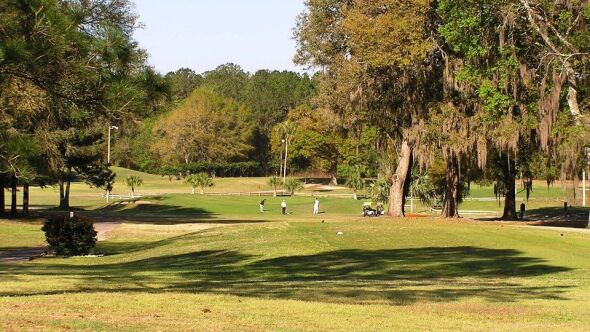
Weed finished the long awaited start over in November and the course was opened for play in December of 2001. His brilliant and often aggressive reshaping of the University of Florida has transformed the virtually defenseless little layout into the only golf course of real relevance in north central Florida, the only must-play for fans of strategic, highly intelligent architecture.
Where once the course presented itself matter-of-factly, it now challenges mental perception on nearly every shot and presents the player with sequences of visual incongruity. Most of the serious reworking has been done around the green complexesthere are still plenty of occasions to blast driver off the teeand it is in and around these harrowing sculptures that are found the most mind-bending challenges of both physical and intellectual nature.
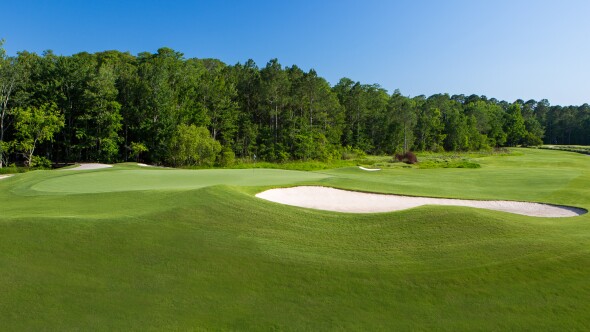
Formerly the course existed squarely above ground but the true horizon of earth is no longer certain. A serious amount of dirt was excavated and transplanted to create surface contrasts. Depressions, bunkers, plateaus, and swales bulge in places where simple, gentle mounds, or nothing at all, existed before.
Though the course is dramatically contoured, the ramifications of the various shapings manifest themselves in subtle ways. Because of the elevations and slopes and the orientations of the greens and what lies beyond them, the continuous margin between a fine shot and a poor shot is often microscopic. For the first time player, the University of Florida may seem fairly simple (it still plays at a brief 6,233 yards for the men, although Weed somehow found nearly 500 additional yards for the tournament tees which now measure 6,701 yards), but as it is replayed, previously unknown dead spots are revealed so that once complacent shots become suddenly quite frightening.
It all folds in to how were trying to create a golf course with more balance between physical ability and mental agility, Weed explains. If youve been out to (the University of Florida course), the more you play there hopefully the more youll understand that.
Hopefully with our golf courses you dont realize how
to play a hole the first time or two you play it, that it takes
time to learn. Theres some places at the University of Florida
that I promise you if you miss it [there] you cannot get up and
down.
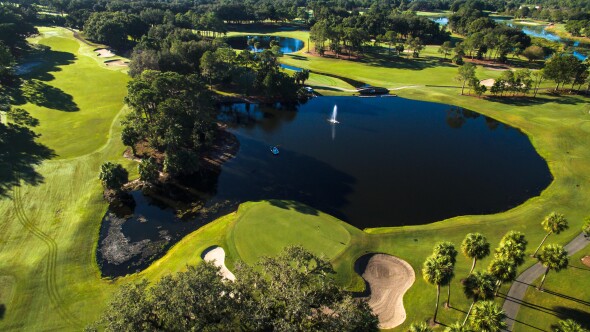
The courses new look is as enticing as its deepened playability. Beyond their fast and furious slope and contour, many of the greens have acquired an engineered, squared off shape that initially seems reminiscent of the work of Seth Raynor. Though obviously man-made, there is grace and invitation in their appearance and somehow they reflect a sense of purpose. The omnipresent bunkering is primarily located at ground level in humps and hollows with shallow entrances, providing for easy maintenance and catch-alls for the frequently occurring slip-away shot.
Though the appearance of the course is far bolder and impressionistic than in the past, its not at odds with what has historically been there.
We took what we liked about the golf course and kept it
and basically what we have now is a brand new golf course but
you still recognize where you are, Weed professes. Its
not like you go out there and you dont recognize anything
about the property, like we flipped it and everything about it
is 100% different. Much of what you see out there you recognize.
You just like it better because weve created a theme, which
I think every golf course needs to have.
Preservationists undoubtedly will worry, but they need not. Though the specter of Donald Ross hovers over each of his many courses and a nation of classical design aficionados cringe when the words Ross course and renovation are uttered in the same sentence, the course is as Ross-like now as it likely has ever been, which is to say not very much at all. But its better and expresses more of the classical design value they are trying to protect than nearly all competing expressions of contemporary architecture.
As Weed explains, The original routing was a 6-6-6 layout and its changed so much and thats the problem. It was a Donald Ross courseand whether it was or whether it wasnt is an arguable pointbut there was virtually nothing Ross about the golf course. It had changed so much over the years. It had different holes, it didnt have a driving range early on, it had six threes, six fours, and six fives, and its been changed, been renovated, remodeled.
Some of the original routing was still in tact, but the
golf course was on 116 acres and that includes the clubhouse,
the parking lot, the maintenance building, the cart storage, the
driving range, the 18 holes, and the new team practice facility.
Thats pretty tight. And theres still some tightness
to the course, but I think it works pretty good now.
Weed reversed several of the parallel north/south running holes at the western side of the property, eliminated the old back-to-back par threes at the 14th and 15th to create a new par four 14th in their wake, and added a new par 15th heading west. The rest of the holes were reshaped significantly, enhanced with bunkers, and re-grassed. Dozens of trees were taken down or relocated to open up views and angles.
We tried to bring some continuity back to the golf course, and tried to instill a (more) strategic design and tie it all in to make (it) flow to create more of a theme. We took a very simple approach because the ground had great topo, great roll to it, and some great trees and vegetation. We just tried to simplify that and polish it, polish it with good options and variety.
Ultimately the new University of Florida design is more feature-rich
than any other course within 90 miles. Its is arguably Weeds
finest work, especially considering the source and constraints.
His attention to detail is evident everywhere. The inspired drive
from the elevated clubhouse tee, always a wonderful start, now
provides a visual of nearly ¾ of the course through the
trees while also calling attention to a comforting, yet atypically
large, field of fairway to the left of the shifted 1st green.
The humps and swales of the indescribably shaped green at the
17th, a reachable downhill par four of 296 yards with options
modeled after those of the 10th at Riviera, are equally mysterious.
Each hole seems to contain some notable attribute, some feature to cause concern or multiply option. Staggered bunkers in the landing area, first left and then right, can cause indecisive drives at number one, and the small, mouthy bunker to the greens short left seems to draw attention far greater than its size would indicate. At the fourth, the towering tree on the left side of the fairway must be negotiated, dominant at a mere 200 yards off the tee.
The two par fives on the first nine possess wickedly tumultuous greensthe third has a false front and a false back rightand it must be decided early on whether best to approach these with full wedge or to tempt their contour by assuaging them with the deftest of chipping touches.
At the long par three sixth, formerly an 8- or 9-iron approach,
shots that travel too far will tumble off the earth and result
in unpracticed plays from 15 feet or more below the green. Being
over the greens at the University of Florida is the worst of fates.
These areas provide some of the most interesting up and downs
imaginable, frequently giving new meaning to the word dead.
Its difficult to describe the movement and subtle shaping at the University of Florida. Many of the finer points of the design arent realized until all the pin placements have been seen, especially the Sunday pins. When the course is playing fast and firm, these pins can be ticklish at best, nightmarish at worst, and its not uncommon to see putts rolling ten or fifteen yards off the green at the 9th, 11th or 13th holes, or see chips return to the players feet from the greens on 3, 7, or 17.
The story now is that the University of Florida course is not going to lay down and take it anymore. Like any course, it will certainly yield low scores to the skilled player in command of his game, but more often than not, it will leave the player flabbergasted who has not carefully thought about his approach or made the dire mistake of placing his or her ball in the wrong position. So when Weed says, Were trying to bring back courses that challenge the mental side of the game, hes not kidding.
University of Florida Golf Course
2800 SW 2nd Ave.
Gainesville, FL 32607
Phone: (352) 375-4866
Vitals
Opened: 1921
Architect: Donald Ross
Renovated: Many times, most recently Bobby Weed (2001)
Yardage: 6,701; 6,233; 5,773; 5,119 yards
Par: 35-35-70
Location
The University of Florida Golf Course is located just west of campus off 2nd Avenue, east of the 34th Street intersection.
Rates
The course is open to those who have ties to the University of Florida (students, faculty, alumni, professors, spouses) plus their guests. Prices are broken down by association, and range from $20 (student rate) up to $50. Readers should do what it takes to see this significant, energetic design.
Walkability
As expected, the University course is tightly routed and an imminently pleasurable walk. Walking is permitted with the exception of early Sundays.
Golf Vacation PackagesFlorida Golf Travel - 866-521-2331 |