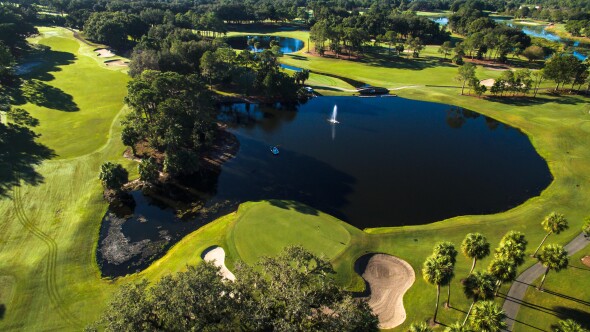
Turkey Creek Golf Course

Rating Snapshot


About
Formerly known as Plantation Oaks Golf Club and Gainesville National Country Club.
| Tee | Par | Length | Rating | Slope |
|---|---|---|---|---|
| Blue | 72 | 6570 yards | 70.7 | 121 |
| White | 72 | 6200 yards | 69.2 | 117 |
| Red (W) | 72 | 5580 yards | 70.2 | 119 |
| Hole | 1 | 2 | 3 | 4 | 5 | 6 | 7 | 8 | 9 | Out | 10 | 11 | 12 | 13 | 14 | 15 | 16 | 17 | 18 | In | Total |
|---|---|---|---|---|---|---|---|---|---|---|---|---|---|---|---|---|---|---|---|---|---|
| Blue M: 70.1/126 | 379 | 508 | 355 | 166 | 324 | 502 | 362 | 139 | 398 | 3133 | 474 | 367 | 354 | 381 | 142 | 510 | 404 | 154 | 430 | 3216 | 6349 |
| White M: 68.9/124 W: 74.8/126 | 366 | 488 | 344 | 161 | 312 | 485 | 351 | 122 | 378 | 3007 | 459 | 360 | 341 | 358 | 132 | 495 | 392 | 142 | 406 | 3085 | 6092 |
| Red M: 65.5/116 W: 70.6/118 | 333 | 384 | 298 | 141 | 284 | 434 | 311 | 108 | 341 | 2634 | 358 | 322 | 311 | 339 | 113 | 443 | 346 | 128 | 348 | 2708 | 5342 |
| Green M: 60.8/104 W: 64.3/105 | 250 | 300 | 260 | 140 | 240 | 380 | 245 | 108 | 275 | 2198 | 300 | 245 | 245 | 265 | 113 | 325 | 280 | 90 | 285 | 2148 | 4346 |
| Handicap | 8 | 4 | 16 | 14 | 10 | 6 | 12 | 18 | 2 | 7 | 11 | 13 | 9 | 17 | 3 | 5 | 15 | 1 | |||
| Par | 4 | 5 | 4 | 3 | 4 | 5 | 4 | 3 | 4 | 36 | 5 | 4 | 4 | 4 | 3 | 5 | 4 | 3 | 4 | 36 | 72 |
| Handicap (W) | 8 | 2 | 12 | 16 | 14 | 4 | 10 | 18 | 6 | 3 | 7 | 13 | 9 | 17 | 1 | 11 | 15 | 5 |
Course Details
Rentals/Services
Practice/Instruction
Policies
Food & Beverage
Bar, Grill, CateringAvailable Facilities
Clubhouse, Banquet FacilitiesAvailable Activities
Swimming, BilliardsAvailable Sports
TennisReviews
Reviewer Photos

Greens in excellent condition. Fairways are under grown
Getting better
Some improvement on cart paths, greens getting better still areas of fairways need work
They need to fix tee boxes and fairways
Not worth the money for a course that's in such poor shape. Go to Ironwoord, Lake City, Ocala. Anywhere but here. Definitely not worth the money.
Needs an Update
Tee boxes, fairways, and some greens are bad. Trees are overgrown in areas and tree roots are everywhere. Mostly because there is no grass on the rock hard fairways. Definitely not worth what they charge.
How can you have a tournament here?
Bad tee boxes, bad fairways, bad traps, greens ok. Not in the shape you'd expect for a tournament.

Horrible fairways
No grass on half the fairways. Definitely not worth the cost. Tee boxes were like the Flintstones. No sand in sand traps. Overall it's a dog track but more expensive than other options.
Fairways Need Help
Love this course layout and 19th hole bar/grill!
The fairways are in horrible shape and tees are sandpits.
Driving range is really nice.
Fix the Fairways!
The recently raised their rates. I have no idea why because the course was in much better shape in the past. The fairways are mostly dirt or bad grass. Many of the tee boxes are like pastures. The greens are pretty good. We used to play here three times a week and now it might be once because you can drive a little further and find much nicer courses for less money. Fix the Fairways!
Nice place to play
This was the second time we've played this course in the past month. The tee boxes are in fair to good condition. The the greens were in good shape and the pace of play was excellent. There fairvways are very thin, but that seems to be normal for the area's public courses this time of year.
The driving range was closed both times we played. That is a major draw back for me since I need to warm up before I hit the first tee to have a good round. I would have rated the course higher had the range been open.
Not coming back for awhile
C'mon people, fix the turf. This is a great course layout. You have very good facilities. The greens, tees & bunkers all good. But on nearly every hole. No grass on the fairways. It's very sparse & us golfers, have to hit on sand mostly. It's an unacceptable condition. The course seems too have plenty of golfers who play there. I come up from Ocala to play it. But I won't be back for awhile. Previously I cut it some slack, believing it would improve. But no, it's getting worse (much worse). So, to the owners of Turkey Creek. Figure out how to build a solid, dense fairways hitting surface your current turf is unacceptable.
Over Priced
Played this course a year ago and thought it was decent value for the price. Price has gone up a lot and the course isn't much better than a year ago. What was once pretty good value for price is no longer the case. Priced themselves out for the quality being delivered.
Practice facilities are good and reasonably priced.
Course Looking Good
Course is in very good shape now coming out of the winter and steadily have gotten the greens into good shape. Course can be challenging with trees lining fairways but overall very easy to play. Great practice facilities
Get the turf in order
This is my third time playing. I really like the layout. Greens, tee's & bunkers are in good shape. The only problem is the thin & very sporadic turf. A lot of areas where there just isn't any grass. Yes, you can generally bump the ball to an area you could hit from. But they need to fix this one problem. And I want to mention how they do there range balls. They allow you to purchase 10 balls for a dollar. I love this, because I like to hit 10-20 balls to warm up. There system is just perfect. And you don't feel like your being gouged.



World Golf Village Stay & Play Package

Sawgrass Marriott Golf Resort Stay & Play Package

Hammock Beach Stay & Play Golf Package

Omni Amelia Island Resort Stay & Play Package